





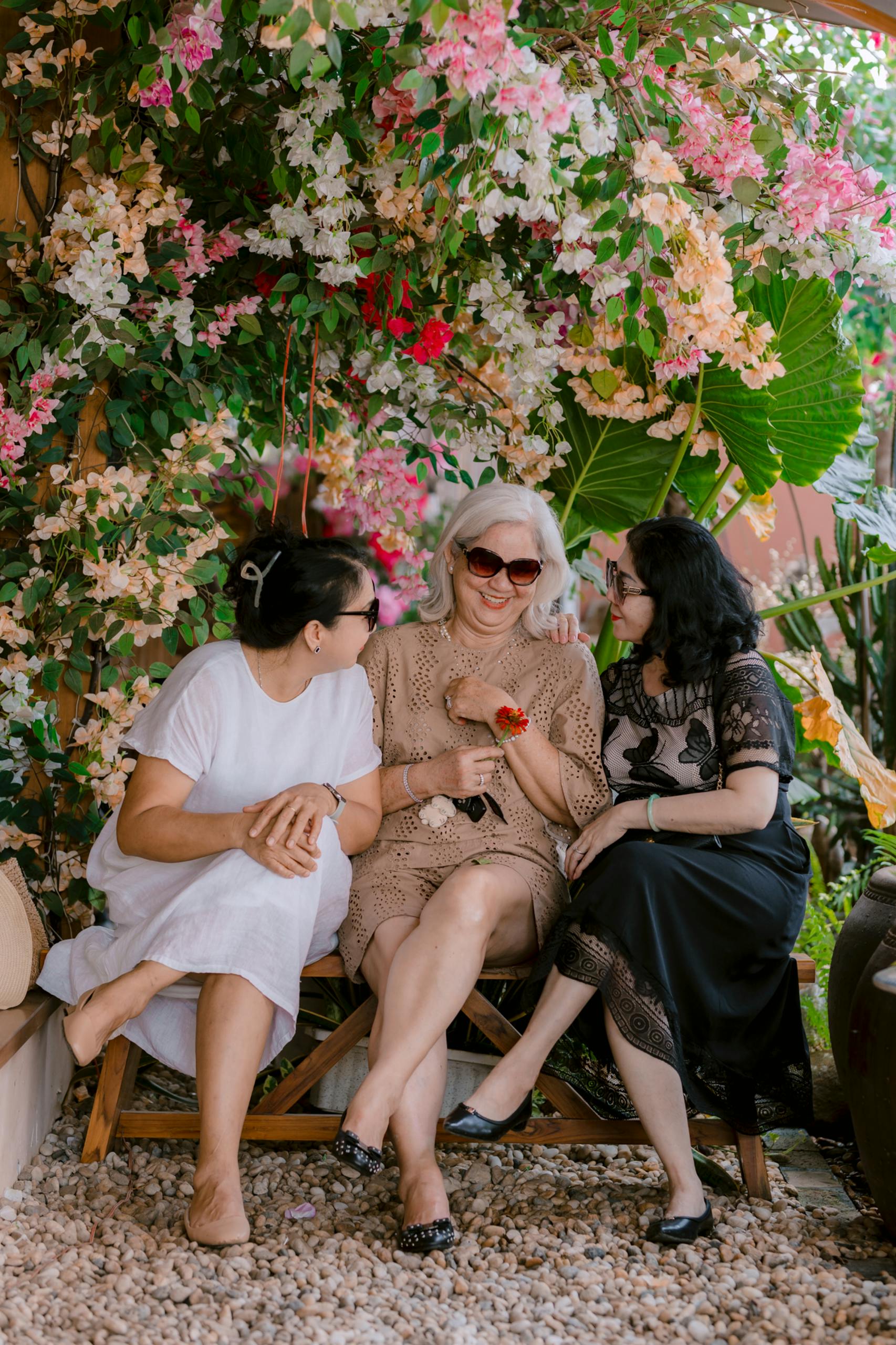
The Gift of Cultural Friendship: Why Connecting Across Cultures Changes You
There is a particular kind of conversation that only happens across a significant cultural distance. You are talking about something ordinary — how you grew up, what your family ate, what you believed as a child, what silence means — and you realize that what felt like a universal experience is, in fact, a specific one. That your way of organizing a family meal, or marking a death, or understanding the obligation between parent and child, is not the only way. That there are people in the world — sitting across from you right now — who have organized their lives around different assumptions entirely, and that those assumptions are not inferior or superior to yours. They are simply different. And the difference is illuminating.
For adults over 50, cross-cultural friendships offer something that is genuinely difficult to find elsewhere at this stage of life: the experience of being genuinely surprised by another person. The feeling, increasingly rare in long-established social circles, of having your understanding of the world revised in real time. Of learning something you did not know you did not know.
What Happens to Us in Cross-Cultural Relationships
The research on intergroup contact — relationships between people of different cultural, ethnic, or national backgrounds — is one of the more robustly optimistic bodies of social science. Contact theory, developed by psychologist Gordon Allport in the 1950s and extensively refined since, holds that meaningful personal contact between members of different groups reduces prejudice, increases empathy, and expands the sense of who counts as “us.” This is not a small finding. It suggests that the act of genuine friendship across difference is itself a form of moral growth.
For older adults specifically, the cognitive benefits of cross-cultural engagement are significant. Navigating a relationship with someone from a different cultural background requires more active mental engagement than navigating familiar relationships — more careful listening, more willingness to hold uncertainty, more flexibility in interpreting behavior and intention. These are demanding cognitive tasks that exercise exactly the kind of executive function and perspective-taking capacity that supports healthy aging.
But the most important effects may be harder to measure. Older adults who develop meaningful cross-cultural friendships consistently describe a sense of expansion — of the world becoming larger, more various, more interesting than it seemed from within a culturally homogeneous social circle. They describe revising assumptions they did not know they held. They describe being taught things — about food, family, spirituality, history, beauty — that they had no framework to even imagine before.
The Obstacles Are Real — and Surmountable
Adults over 50 face specific challenges in building cross-cultural relationships that are worth naming honestly. Social networks tend to homogenize over time: by the mid-50s, many people’s closest relationships are with people who grew up similarly, live similarly, and share a broadly similar cultural frame. The structural opportunities for cross-cultural encounter — the diverse workplace, the mixed neighborhood, the multicultural university — may have receded.
There is also the weight of history. Depending on your background and the backgrounds of others, cross-cultural relationships may carry the weight of historical grievances, inherited assumptions, or simple unfamiliarity. These are real, and pretending otherwise serves no one. But they are not insurmountable — not with genuine curiosity, genuine humility, and the willingness to be changed by what you encounter.
The practical solution to opportunity is intentionality. Cross-cultural friendships are unlikely to happen by accident at this stage of life. They happen through the deliberate choice to put yourself in settings where cultural encounter is possible: language exchange programs, international community organizations, multicultural faith communities, volunteer work with immigrant populations, and the full range of cultural arts experiences that bring diverse communities together.
The Posture That Makes It Work
The quality that most consistently enables cross-cultural friendship is not tolerance — a word that implies barely suppressed discomfort — but genuine curiosity. The willingness to ask questions, to not know, to be instructed by someone who has lived differently. This posture requires the suspension of the assumption that your way is the default, the norm against which other ways are measured.
It also requires what anthropologists call “cultural humility” — the recognition that you will never fully understand another culture from the outside, and that this limitation is not a failure but a permanent condition. The goal is not mastery. It is relationship. And relationship is built not through understanding everything about someone’s culture but through genuine interest in their specific, individual experience of it.
What you will find, as you build these relationships, is that the specific always exceeds the general. The Japanese woman you thought you understood through a film or a travel book is a specific person with specific opinions about her culture that neither the film nor the book anticipated. The Nigerian man whose country you visited five years ago has a perspective on that country that your guidebook never reached. People are always more complicated, more interesting, and more surprising than their cultural category. That is exactly the point.
Where to Begin
Begin anywhere. Take a cooking class in a cuisine you don’t know. Attend a cultural festival in your city with the intention of talking to people, not just watching. Sign up for a language exchange. Volunteer with an immigrant services organization. Say yes to an invitation from a neighbor whose background differs from yours. The first step is not a program or a system. It is a decision — to let your world become larger — and then the first action that follows from it.
The friendships that result from this decision are not guaranteed to be easy or immediate. Real relationships, across any distance, take time and effort and the willingness to persist through misunderstanding. But the ones that develop — the friendships built on genuine mutual curiosity and the willingness to be changed — are among the most alive and most enlarging relationships available at any age. At 55, or 65, or 75, there is still so much of the world to encounter. And the best way to encounter it is through the people who have lived it.
[…] The Gift of Cultural Friendship: Why Connecting Across Cultures Changes You […]
[…] The Gift of Cultural Friendship: Why Connecting Across Cultures Changes You […]
[…] The Gift of Cultural Friendship: Why Connecting Across Cultures Changes You […]
[…] The Gift of Cultural Friendship: Why Connecting Across Cultures Changes You […]
[…] The Gift of Cultural Friendship: Why Connecting Across Cultures Changes You […]
[…] The Gift of Cultural Friendship: Why Connecting Across Cultures Changes You […]
[…] The Gift of Cultural Friendship: Why Connecting Across Cultures Changes You […]
[…] The Gift of Cultural Friendship: Why Connecting Across Cultures Changes You […]
[…] The Gift of Cultural Friendship: Why Connecting Across Cultures Changes You […]
[…] The Gift of Cultural Friendship: Why Connecting Across Cultures Changes You […]