





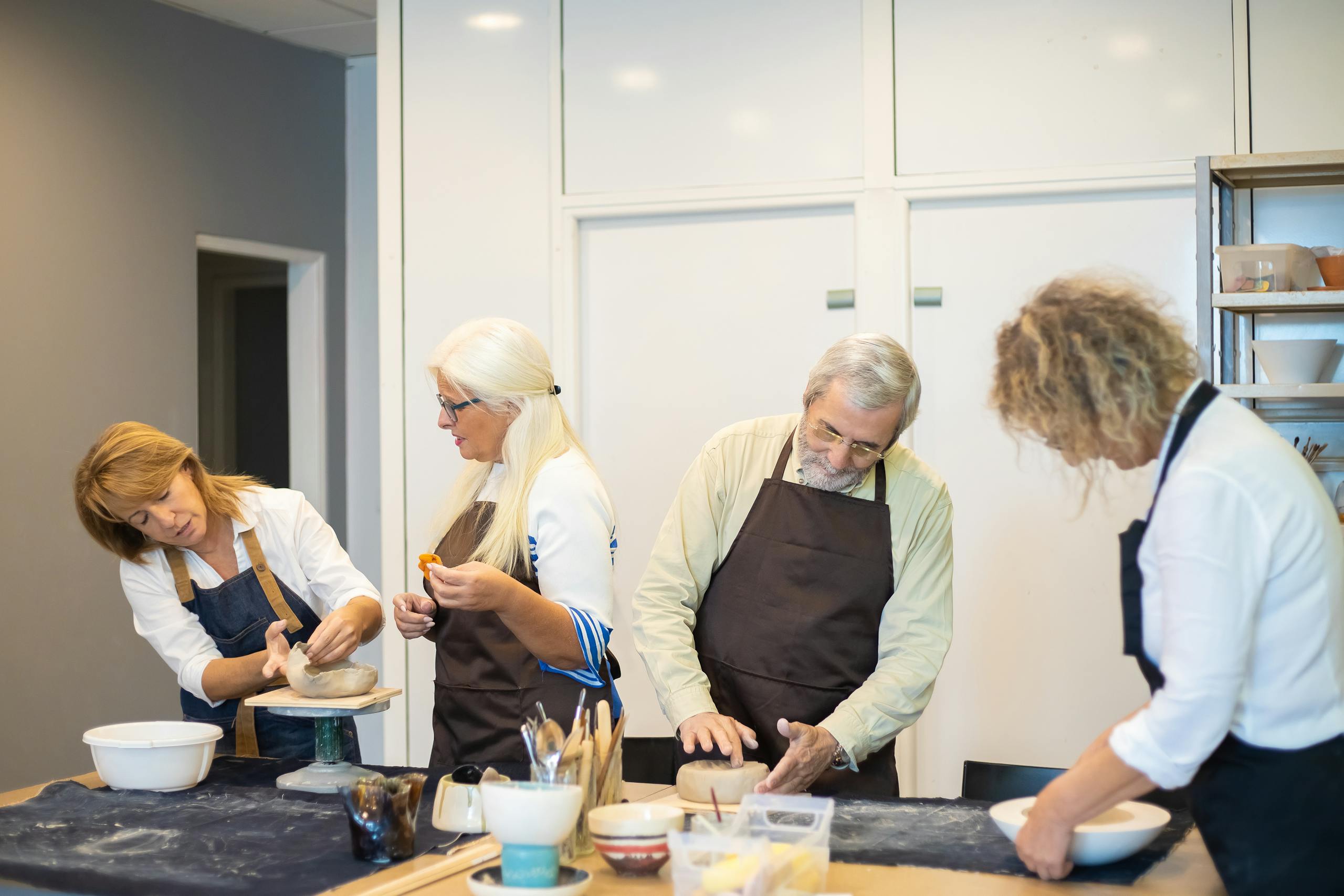
Pottery and Ceramics for Older Adults: Finding Your Hands in Clay
There is something ancient and deeply satisfying about making things from clay. Humans have been shaping vessels, figures, and tiles from earth for at least 25,000 years. The earliest known ceramic objects predate agriculture. Something in this practice connects us to a lineage so long it defies imagination — and something in the physical act itself, the weight of the clay, the pressure of the hands, the slow emergence of form from formlessness, speaks to something that screens and keyboards cannot reach.
Pottery has experienced a genuine renaissance over the past decade, driven partly by the wildly successful Netflix series The Great Pottery Throw Down, partly by a cultural appetite for the handmade, and partly by something simpler: people discovered that working with clay is profoundly satisfying in ways that are hard to articulate and easy to feel. For older adults, ceramics offers a particularly rich combination of physical engagement, creative expression, and social connection.
What Ceramics Offers Older Adults
The benefits of working with clay are well-documented and distinctly suited to later life. The tactile engagement required — kneading clay, centering it on the wheel, shaping walls with the fingertips — maintains fine motor skills and hand strength. The focused attention required to keep a vessel centered on a spinning wheel is a genuine mindfulness practice: it is simply impossible to be anywhere else mentally when you are throwing. Anxiety, rumination, and distraction cannot survive the potter’s wheel.
Research on art therapy with older adults consistently finds ceramics among the most effective modalities — particularly for those managing grief, depression, or chronic pain. The combination of repetitive, rhythmic hand movement and tangible creative output appears to activate emotional regulation pathways in ways that are both immediate and lasting.
There is also the irreplaceable satisfaction of functional making. A bowl you throw yourself is not just an aesthetic object. It is something you can eat soup from. It connects the creative act to the everyday life of the body in a way that purely decorative art does not. Many ceramicists describe a specific joy in using their own work — setting the table with mugs and plates they made with their hands.
The Main Forms of Ceramics
Wheel throwing is what most people picture when they imagine pottery — a lump of clay centered on a spinning wheel, drawn upward into a vessel by the pressure of wet hands. It is the most technically demanding form of ceramics and takes the most time to learn. It also offers the greatest range of functional vessel forms: bowls, cups, mugs, vases, plates. The learning curve is real — most beginners produce lopsided, collapsed, or otherwise imperfect results for their first several sessions — and this is the point. The imperfection is not failure. It is the process.
Hand building encompasses three primary techniques: pinching (forming vessels directly with the fingers), coiling (building walls from ropes of clay), and slab building (constructing forms from flat sheets of clay). Hand building does not require a wheel and is accessible to people with a wider range of physical abilities. It is also, arguably, the form closest to the ancient roots of ceramics — and it produces work of extraordinary variety and visual interest.
Sculpting moves beyond vessels into three-dimensional form: figures, animals, abstract objects, relief tiles. It requires the least technical infrastructure and the most imaginative freedom.
Finding a Studio or Class
Unlike painting or drawing, ceramics requires access to equipment that most people cannot easily have at home — primarily a kiln (the high-temperature oven that fires clay into permanent ceramic) and, for wheel throwing, a pottery wheel. This makes a community studio or class almost essential for the beginning ceramicist.
The good news is that ceramics studios exist in virtually every mid-sized city and many smaller ones. Community art centers, senior centers, community colleges, and dedicated ceramics studios all offer classes for adult beginners. These classes typically provide all materials and equipment, with instruction from working ceramicists.
Many studios also offer open studio membership — access to wheels, tools, and kiln time for a monthly fee, with the freedom to come and go on your own schedule. For those who have completed a beginner class and want a regular practice, open studio membership is the natural next step.
What to Expect in a Beginner Class
A typical introductory ceramics class runs six to eight weeks, meeting once or twice per week for two to three hours per session. In the first session, you will learn to wedge clay (a kneading process that removes air bubbles and creates uniform consistency) and will make your first attempt at centering on the wheel or building by hand, depending on the course focus.
Your first pieces will almost certainly not look the way you imagined them. This is universal and expected. Pottery is a skill that unfolds over months and years, not sessions. The beginner who focuses on the process — the feel of the clay, the problem-solving of each new form — learns faster and enjoys the experience more than the beginner who fixates on the outcome.
By the end of a six-week course, most students have produced several pieces that have been bisque-fired (the first firing), glazed, and glaze-fired into finished, functional ceramics. Holding a completed mug that you made from raw clay is a specific kind of satisfaction that is worth experiencing.
The Community of Clay
One thing that surprises many new ceramicists is how warm and collaborative the ceramics community tends to be. Studios have a social life: people share glazing tips, admire each other’s work, offer help with a difficult form, and gather around the kiln opening when the latest firing is revealed. There is a democratic quality to the ceramics studio — everyone is working with the same recalcitrant material, and everyone has disasters and triumphs in roughly equal measure.
For those who find that ceramics becomes a serious pursuit, local ceramic arts societies and national organizations like the American Craft Council offer community, exhibitions, and opportunities to see and purchase work from professional ceramicists. Regional ceramics conferences and workshops bring together practitioners at every level for intensive learning experiences that are as much about community as they are about clay.
The clay will not always cooperate. The kiln will sometimes surprise you in the wrong direction. But in a ceramics studio, surrounded by people who are also covered in clay and also making something from nothing, you will find a community that is hard to replicate anywhere else.
[…] Pottery and Ceramics for Older Adults: Finding Your Hands in Clay […]
[…] Pottery and Ceramics for Older Adults: Finding Your Hands in Clay […]