





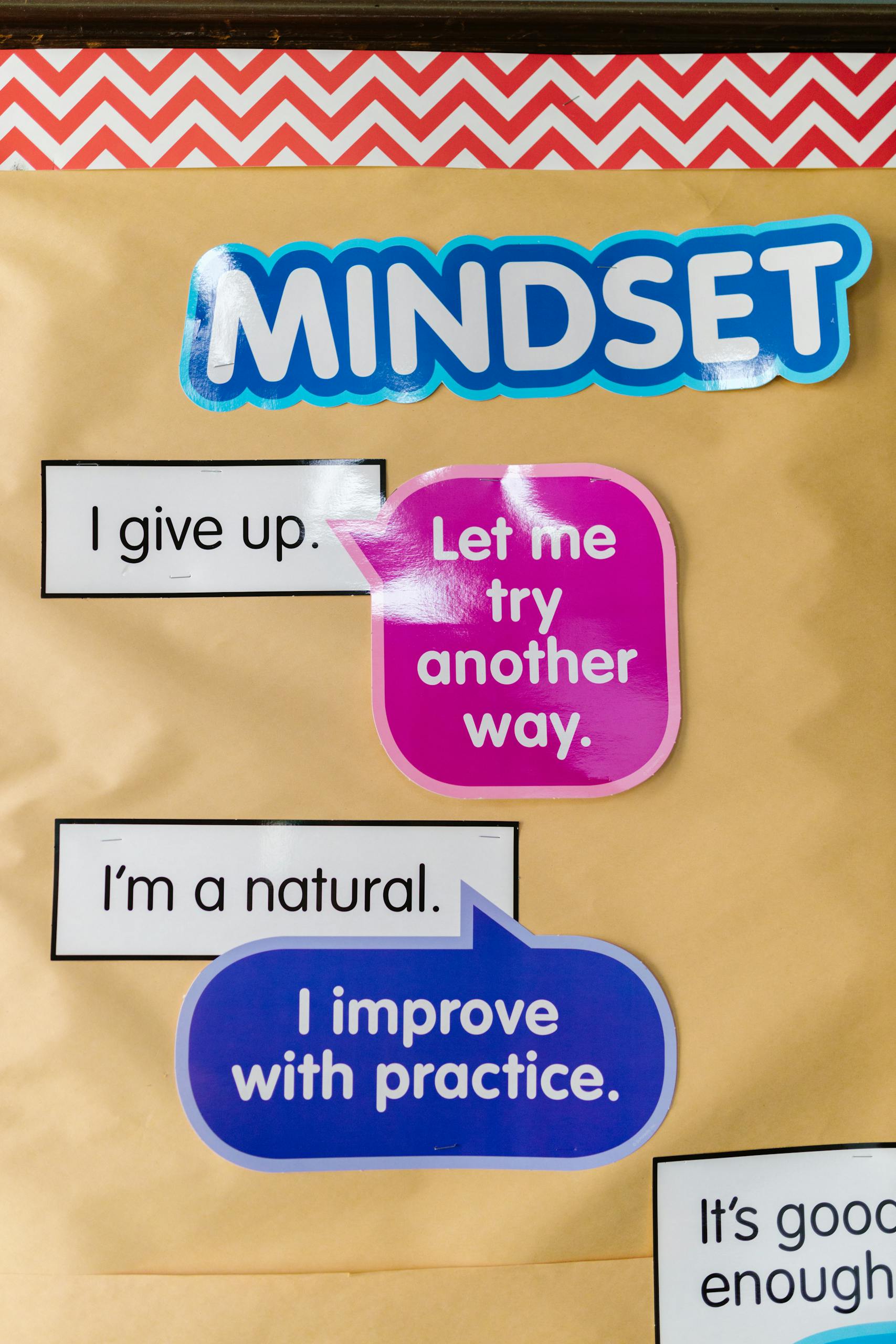
It’s Never Too Late: How to Unlock a Growth Mindset After 50
Carol Dweck’s concept of the growth mindset — the belief that abilities, intelligence, and character can be developed through effort and learning, rather than being fixed traits — was initially studied in the context of children and academic performance. But its implications for adults navigating major life transitions may be even more significant.
The fixed mindset in midlife and beyond has a particularly insidious quality: it masquerades as wisdom. “I know myself well enough to know what I’m good at” can be the voice of genuine self-knowledge or the voice of a fixed mindset that has rationalized its resistance to growth into something that sounds mature. Distinguishing between the two is the first challenge.
What a Fixed Mindset Sounds Like in Midlife
The fixed mindset in later life speaks in the language of limitation and finality: “I’m not a tech person.” “I’ve never been good at making friends in new environments.” “I’m too set in my ways to change now.” “That’s just not who I am.” These statements feel like self-awareness, but they function as self-imposed ceilings — predictions that become self-fulfilling because they eliminate the attempt.
The research on neuroplasticity has definitively established that the adult brain retains the capacity for significant change and learning throughout life. The 55-year-old brain is not the 25-year-old brain, but it is not the static structure that popular mythology suggests. New skills can be learned, new habits can be built, and new capacities can be developed — the conditions required are effort, appropriate challenge, and the belief that change is possible.
The Neuroscience of Growth in Later Life
Neuroplasticity — the brain’s ability to reorganize itself by forming new neural connections — persists throughout the lifespan, though the conditions that support it shift with age. For adults over 50, the most effective conditions for neuroplastic growth include: learning that is genuinely challenging (not just within the comfortable range of existing competence), regular aerobic exercise (which promotes the production of BDNF, a protein that supports neural growth and connectivity), adequate sleep (during which the consolidation of new learning occurs), and social engagement (which provides the cognitive stimulation that maintains mental sharpness).
This is not a minor caveat to the growth mindset argument — it’s foundational support for it. The biological substrate of growth remains available. The limiting factor is overwhelmingly psychological, not physiological.
Practical Ways to Cultivate a Growth Mindset
Reframe challenges as learning opportunities, not performance tests. A fixed mindset evaluates challenges in terms of success or failure relative to a fixed standard. A growth mindset asks: “What can I learn from this? What did this experience teach me about what I need to develop?” This reframe doesn’t eliminate the discomfort of difficulty — it changes what the discomfort means.
Notice and challenge your “I’m not a…” statements. Every time you catch yourself saying “I’m not a person who…” or “I’ve never been good at…”, treat it as a data point worth examining rather than a settled fact. Is this actually true, or is it a story you’ve repeated long enough that it feels true? Has anyone similar to you ever developed this capacity? If so, what conditions enabled it?
Deliberately pursue beginner experiences. One of the gifts of the growth mindset is the capacity to enjoy being a beginner — to find value in early-stage incompetence rather than being humiliated by it. Take up a skill that you have no existing competence in: a language, an instrument, a physical practice, a creative medium. The experience of being a beginner at something new in your 50s is, paradoxically, one of the most effective ways to recapture the sense of aliveness that comes from genuine learning.
Seek out growth-oriented community. Mindsets are contagious. People who approach challenges with curiosity and optimism create social environments that make growth orientation easier to maintain. Deliberately spend time with people who are actively learning, building, and experimenting — regardless of age.
Growth Mindset Is Not Toxic Positivity
A common misreading of the growth mindset concept is to conflate it with relentless optimism or the denial of real constraints. A growth mindset does not claim that anything is possible with enough effort, that all challenges can be overcome, or that difficulty should be cheerfully embraced. It claims only that capacity can develop — and that the belief that it cannot is reliably wrong.
Real constraints exist. A 55-year-old is not going to play in the NBA regardless of mindset or effort. But most of the limitations that people in midlife accept as fixed — “I can’t learn new technology,” “I can’t build a new social network in a new city,” “I can’t develop a new professional skill set” — are not real constraints. They are fixed mindset positions that prevent the attempt, which ensures the prediction comes true.
The growth mindset, properly understood, is simply the commitment to finding out rather than assuming you already know the answer.
[…] Developing a Growth Mindset in Your 50s and Beyond […]